While Nepal is home to a spectacular diversity of birds of prey, they remain one of the country’s least-studied avian groups. Traditionally, research has focused heavily on a few high-priority vulture species following their dramatic population declines in the early 2000s. To address the resulting capacity gap in studying other vital raptors—such as eagles, hawks, and owls—The Himalayan Raptors, in collaboration with multiple national and international partners, concluded an intensive four-day professional training program on Raptor Study Design and Research Techniques.
The workshop brought together 17 ambitious early-career researchers and graduate students from Kathmandu University, the Institute of Forestry (Pokhara and Hetauda), Central Department of Zoology – Tribhuvan University and the Central Campus of Technology (CCT), Dharan.
From Fundamentals to Advanced Field Tech
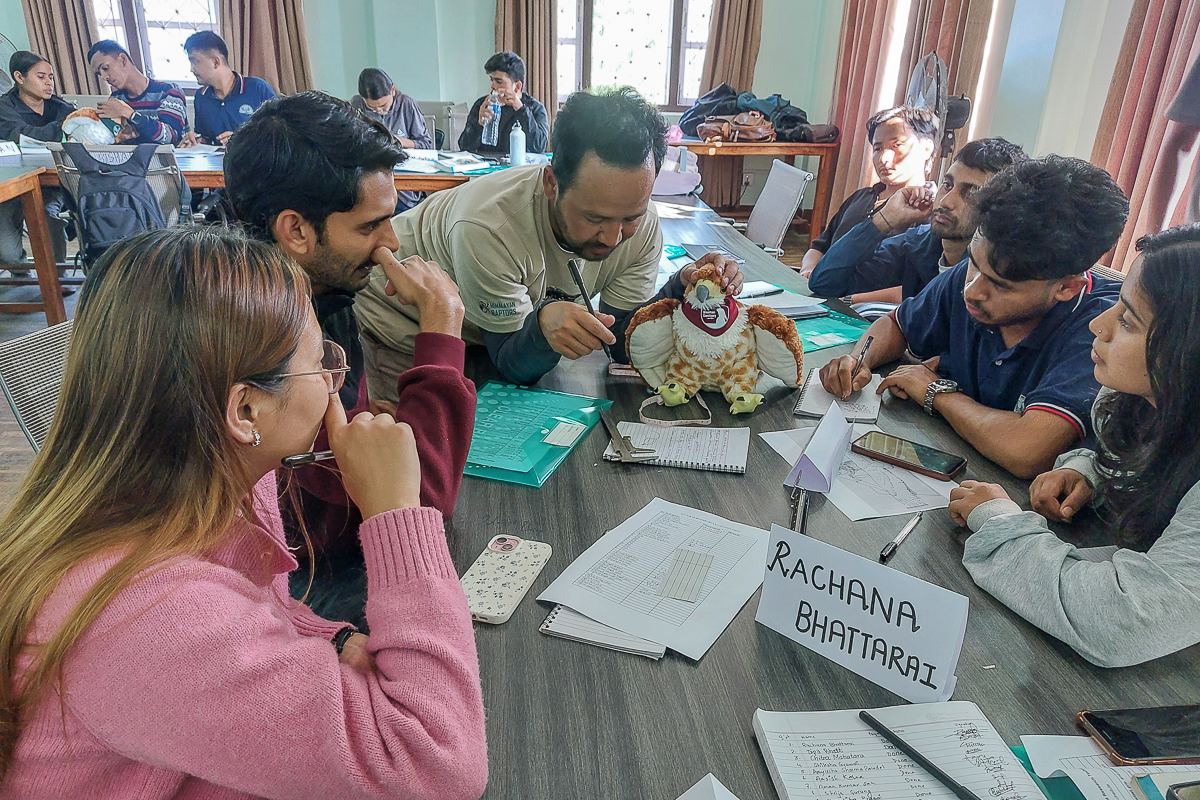 The four-day curriculum combined rigorous classroom theory with hands-on field applications, led by a team of global and local experts.
- Foundations & Identification: Dr. Tulsi Subedi, Sandesh Gurung and field expert Dheeraj Chaudhary kicked off the program with sessions on raptor taxonomy, global conservation status, and field identification. Participants moved quickly from theory to practice, using flashcard exercises and stuffed raptor models to master morphometric measurements and topography.
- Movement & High-Tech Monitoring: The second day delved into the "how" of modern conservation. From the theories of movement ecology to the practicalities of trapping, students learned to set bow-net traps, pigeon harnesses, and noose string traps. Special guest lecturers, including Sabin KC (Tribhuvan University) and Dr. Chaiyan Kasorndorkbua (Kasetsart University, Thailand), provided insights into stable isotope analysis, genetics, eDNA, and raptor pathology.
- Ecology & Threat Assessment: Day three focused on the secret lives of raptors—their feeding guilds and breeding biology. A critical session led by Associate Professor Juan Manuel Pérez-García (University Miguel Hernandez, Spain) highlighted the global threat of powerline electrocution, teaching students how to identify "dangerous pylons" and implement mitigation measures.
- Rescue and Ethical Handling: Beyond research, the training emphasized animal welfare. Dr. Subedi covered initial health stabilization and safe transport protocols, while Raju Acharya provided a sobering overview of the illegal owl trade and hunting scenarios in Nepal.
- Research Design and Data Collection:
This session, facilitated by Jiwan Rai, introduced participants to the core principles of research design. Participants engaged in developing research questions, formulating hypotheses, and understanding population-based study methods, thereby establishing a strong foundation for future field research and data collection.
Putting Skills to the Test at Koshi Tappu
The training culminated in an extensive field exercise in the farmlands surrounding the Koshi Tappu Wildlife Reserve. Trainees applied their new skills in real-world conditions, conducting powerline collision surveys, point counts, and transect surveys.
"This training was a remarkable opportunity to share expertise with rising biologists," noted the organizing team. "By strengthening these skills, we are setting up future researchers to conduct the comprehensive work needed to protect all raptor species across the Himalayan landscape."
A Collaborative Milestone
This successful capacity-building effort was made possible through a robust partnership between:
- The Himalayan Raptors
- Nature and Conservation Study Centre (NCSC)
- The Peregrine Fund & Hawk Mountain Sanctuary
- Central Campus of Technology (CCT) & Research Association of Hattisar (RAH)
As these 17 participants return to their respective institutions, they carry with them the specialized tools required to expand Nepal's conservation narrative beyond vultures, ensuring a safer future for every eagle, hawk, and owl in the region.