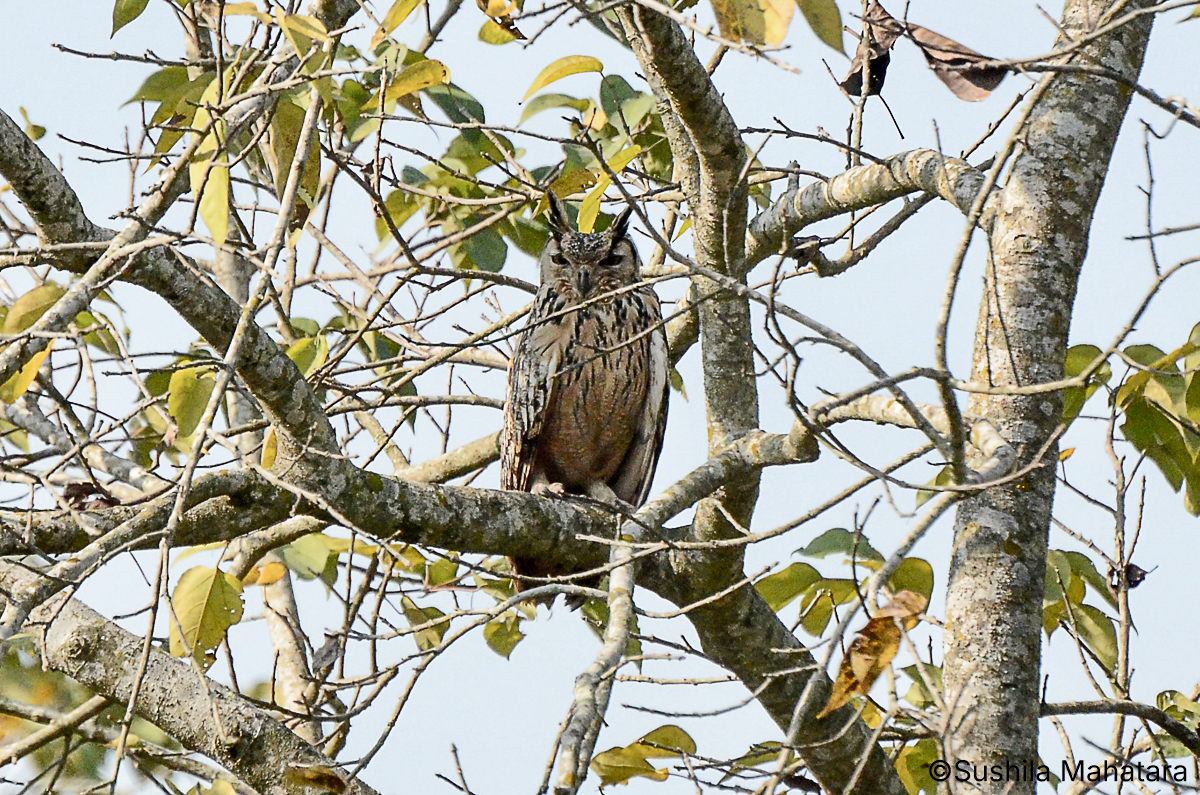
Rock Eagle-Owl
- Common Name: Rock Eagle-Owl
- Scientific Name: Bubo bengalensis
- Nepali Name(s): हाप्सिलो (Haapsilo)
- IUCN Red List Status: Least Concern (LC)
- National Red List Status: Vulnerable (VU)
- CITES Appendix: Appendix II
- CMS Appendix: Not listed
Measurements & Physical Profile
- Body Length: 50–56 cm
- Wing Length: 35.8–43.3 cm
- Weight: 1,100–1,374 g
Did You Know?
The Rock Eagle-Owl is a powerful predator often recognized by its deep, resonant "ooo-wooo" call that echoes across rocky gorges at night. It features prominent, dark ear tufts and a striking facial disc, giving it a fierce appearance, while its plumage provides perfect camouflage against the rugged, rocky outcrops and cliffs it favors for both roosting and nesting.
Distribution & Habitat
Global Distribution
Native to the Indian subcontinent, with its range extending across India, Pakistan, and parts of Nepal. It is primarily found in dry, rocky regions and scrubby hill country throughout its range.
Distribution within Nepal
A rare resident breeder in the hills and inner valleys of Nepal. It is most frequently encountered in the dry, rocky landscapes of central and western Nepal, including deep riverine gorges and hillside cliffs.
Preferred Habitats
Rocky hills, cliffs, deep gorges, and dry, scrubby woodlands. It is highly adapted to areas with rugged terrain, often selecting cliff ledges or rocky outcrops that provide both cover and excellent vantage points for monitoring its territory.
Elevational Range
Primarily found in the mid-hills and inner valleys, ranging from lowland foothills up to approximately 2,000 meters above sea level.
Seasonal Occurrence
Year-round permanent resident. They maintain strict, localized territories within their chosen rocky valley systems throughout the year.
Behavior & Ecology
Flight & Foraging Behavior
Exhibits a powerful, direct, and silent flight. It is a nocturnal hunter that utilizes a "sit-and-wait" ambush method, perching on a rocky ledge or tree branch to scan the area for movement before swooping down with great force to capture prey.
Social & Roosting Habits
Typically seen in bonded, monogamous pairs that defend their territory year-round. They roost cryptically during the day, often hidden on rocky ledges or deep within the shade of large trees, and become highly active at dusk and dawn.
Diet & Ecosystem Role
Diet Breakdown
The Rock Eagle-Owl is a formidable, high-tier nocturnal predator:
- Mammals (Primary): Frequently consumes small to medium-sized mammals, including rodents (rats, mice), hares, and sometimes hedgehogs.
- Birds: Opportunistically hunts gamebirds, pigeons, and other small birds found within its territory.
- Other: Occasionally takes reptiles or large insects if available.
Ecological Role
As an apex nocturnal predator in rocky and hilly forest landscapes, it regulates populations of rodents and small herbivores. This helps maintain the health of the understory and protects vegetation from overgrazing by small mammals.
Breeding Biology
The breeding season in Nepal occurs from December through April. They do not build a formal nest, instead laying their eggs directly in natural hollows on cliff ledges, rocky ground, or occasionally in old nests of other raptors. The female typically lays 3 to 4 (sometimes 2-5) white eggs. Incubation lasts about 33–35 days, and the chicks remain in the care of both parents until they fledge after approximately 52–58 days.
Migration
- Status: Permanent resident; non-migratory.
- Movement: Established breeding pairs stay within their home rocky valleys year-round, showing high site fidelity.
Population Status
- Global Population Estimate: Unknown.
- Population Trend: Decreasing.
- National Population Estimate (Nepal): Unknown.
- Monitoring & Surveys: There are currently no systematic population monitoring activities for this species.
Threats
- Habitat Loss and Degradation: Quarrying, mining, road construction, and urban expansion destroy rocky cliffs and outcrops used for nesting and roosting, reducing suitable breeding habitat.
- Human Disturbance: Tourism, trekking, rock climbing, photography, and livestock grazing near nesting sites can disturb breeding birds, leading to nest abandonment and lower breeding success.
- Illegal Trapping and Trade: The species is threatened by illegal capture for the pet trade, belief-based medicine, and superstition. Eggs and nestlings are also collected, while persecution remains a concern in Nepal and parts of South Asia.
- Secondary Poisoning: Rodenticides and agricultural pesticides can poison owls indirectly through contaminated prey and may also reduce prey abundance in agricultural landscapes.
Conservation Actions
Existing Measures
- Legal Protection: The Rock Eagle Owl is protected under Nepal's national wildlife legislation and is covered by CITES Appendix II, which regulates international trade. The species is also included in Nepal's Owl Conservation Action Plan (2020–2029) due to threats from illegal hunting and trade.
- Protected Areas: The species occurs in several protected areas, including Annapurna Conservation Area, Bardia National Park, and Chitwan National Park, where its habitat receives a degree of legal protection.
Recommended Measures
- Protect Nesting Cliffs: Designate no-disturbance zones around known nesting cliffs during the breeding season and minimize tourism, rock climbing, and other human activities near breeding sites.
- Regulate Quarrying and Infrastructure Development: Require rigorous environmental impact assessments before approving quarrying, mining, road construction, or other developments in rocky habitats used by the species.
- Strengthen Law Enforcement: Improve surveillance and cross-border cooperation to combat illegal hunting and wildlife trade, particularly at known trafficking hotspots.
- Community Awareness and Monitoring: Promote public awareness of the Rock Eagle Owl's ecological role in natural rodent control, engage local communities in nest monitoring, and dispel myths and superstitions that contribute to persecution.
References
- BirdLife International (2024). Species factsheet: Rock Eagle-owl Bubo bengalensis. Downloaded from https://datazone.birdlife.org/species/factsheet/rock-eagle-owl-bubo-bengalensis on 09/08/2026
- Holt, D. W., R. Berkley, C. Deppe, P. L. Enríquez, J. L. Petersen, J. L. Rangel Salazar, K. P. Segars, K. L. Wood, G. M. Kirwan, and J. S. Marks (2020). Rock Eagle-Owl (Bubo bengalensis), version 1.0. In Birds of the World (J. del Hoyo, A. Elliott, J. Sargatal, D. A. Christie, and E. de Juana, Editors). Cornell Lab of Ornithology, Ithaca, NY, USA. https://doi.org/10.2173/bow.roeowl1.01
- Inskipp C., Baral H. S., Phuyal S., Bhatt T. R., Khatiwada M., Inskipp, T, Khatiwada A., Gurung S., Singh P. B., Murray L., Poudyal L. and Amin R. (2016). The status of Nepal’s Birds: The national red list series. Zoological Society of London, UK.
- König, C., F. Weick, and J.-H. Becking (2008). Owls of the World. Second edition. Christopher Helm, London, UK.